The U.S. Navy wants long-range strike drones that can be launched from destroyers and other warships that lack large flight decks, according to a Defense Innovation Unit solicitation.
The concern is that the Navy lacks enough aircraft carriers, aircraft and missiles to sustain an extended conflict against an adversary armed with long-range antiship missiles. Thus, the service is looking for armed drones that can be launched from austere locations or from surface warships other than aircraft carriers.
“Naval surface combatants are constrained in their ability to support long-range strikes over extended combat operations due to reliance on single-use missile systems, with limited magazine depth and limited at-sea munition replenishment capability,” according to the solicitation by DIU, a Pentagon agency charged with developing new technologies. “The long-range strike methods able to persistently support naval surface combatants require infrastructure and assets which are vulnerable, limited or in high demand; including runways, and ships with large flight decks.”
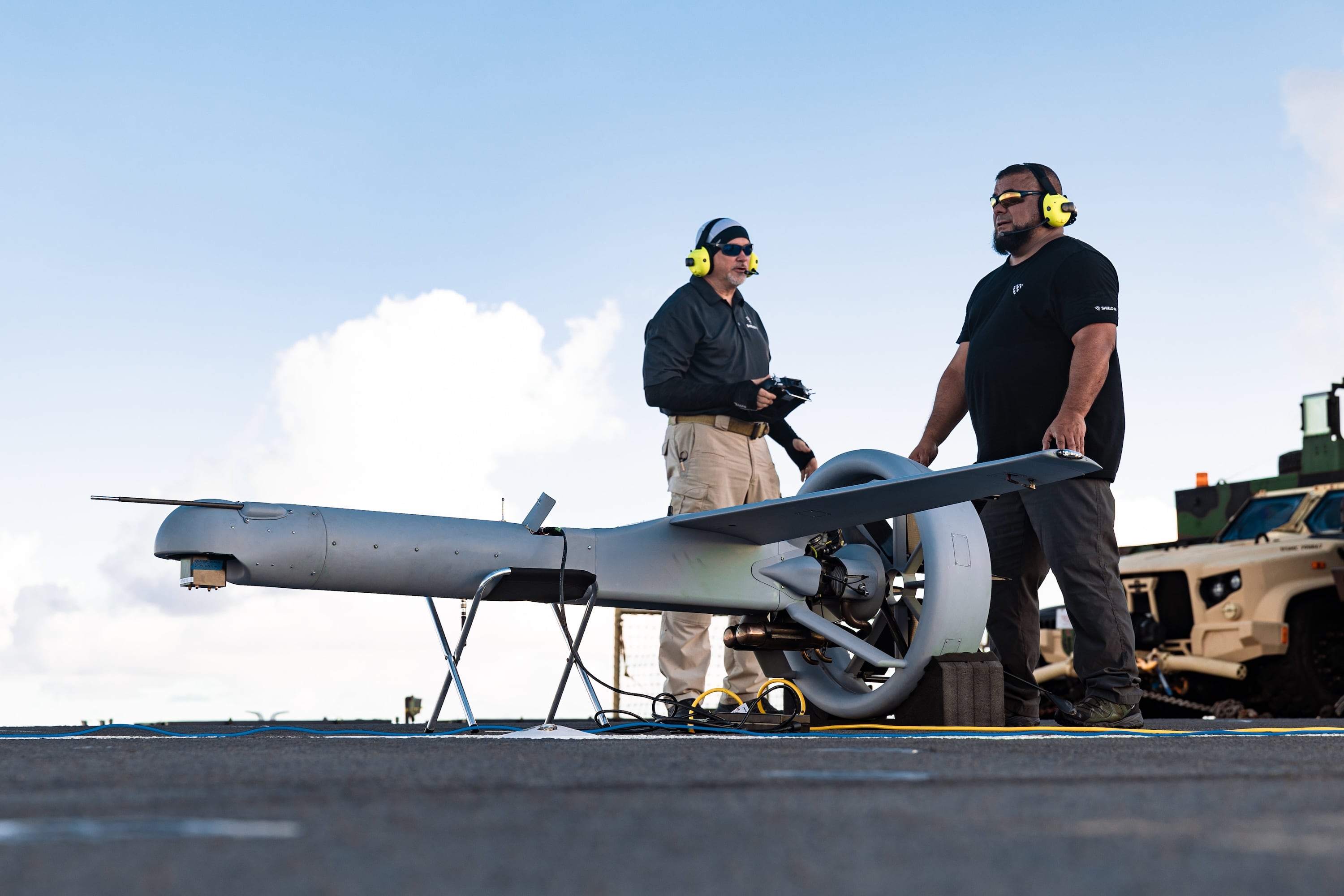
Runway Independent Maritime and Expeditionary Strike, or RIMES, would solve this problem by fielding reusable drones capable of “long-range strikes with standard munition payloads while providing tactical flexibility by operating from expeditionary locations with minimal infrastructure, or from ships without large flight decks,” according to the solicitation.
The solicitation cites surface combatants such as the Arleigh Burke-class destroyers, littoral combat ship and the FF(X) frigate based on the Coast Guard’s Legend-class cutter as potential platforms. While these vessels can launch helicopters, they don’t have large flight decks.
The drone itself would pack a considerable punch when armed with existing 1,000-pound bombs that already equip F/A-18 and F-35C fighter jets, or with palletized munitions.
Range would also be comparable to manned aircraft. The unmanned aerial vehicle should have a “one-way, no-reserve range of at least 1,400 nautical miles in order to allow an approximate 600 nautical mile radius,” DIU specified. As for the UAV’s speed, DIU would only state it should “cruise at a speed comparable to existing long-range strike methods.”
The Navy also appears concerned that the drone be autonomous enough to operate amid jamming and GPS denial. A RIMES drone should “incorporate mission autonomy to execute all mission phases in a highly contested environment,” according to the solicitation.
One question is how sophisticated — or expendable — a system the Navy wants. The solicitation cites cost-effectiveness as a consideration, yet it also mandates that drones should “demonstrate viability to operate in airspace with adversary threats, such as through survivability or attritability.”
Other criteria include a system that can be launched from a ship amid strong winds and waves, minimal need for servicing equipment and personnel, and quick turnaround from storage to launch, and recovery back to storage. The design should use open-system architecture to facilitate easy upgrades.
In line with the Pentagon’s push for speedy development of drones, DIU seeks a UAV that can be quickly mass-produced. “Solutions should demonstrate readiness for significant physical prototyping within 12 months of agreement award,” the solicitation said. The deadline is Feb. 27.
Michael Peck is a correspondent for Defense News and a columnist for the Center for European Policy Analysis. He holds an M.A. in political science from Rutgers University. Find him on X at @Mipeck1. His email is mikedefense1@gmail.com.