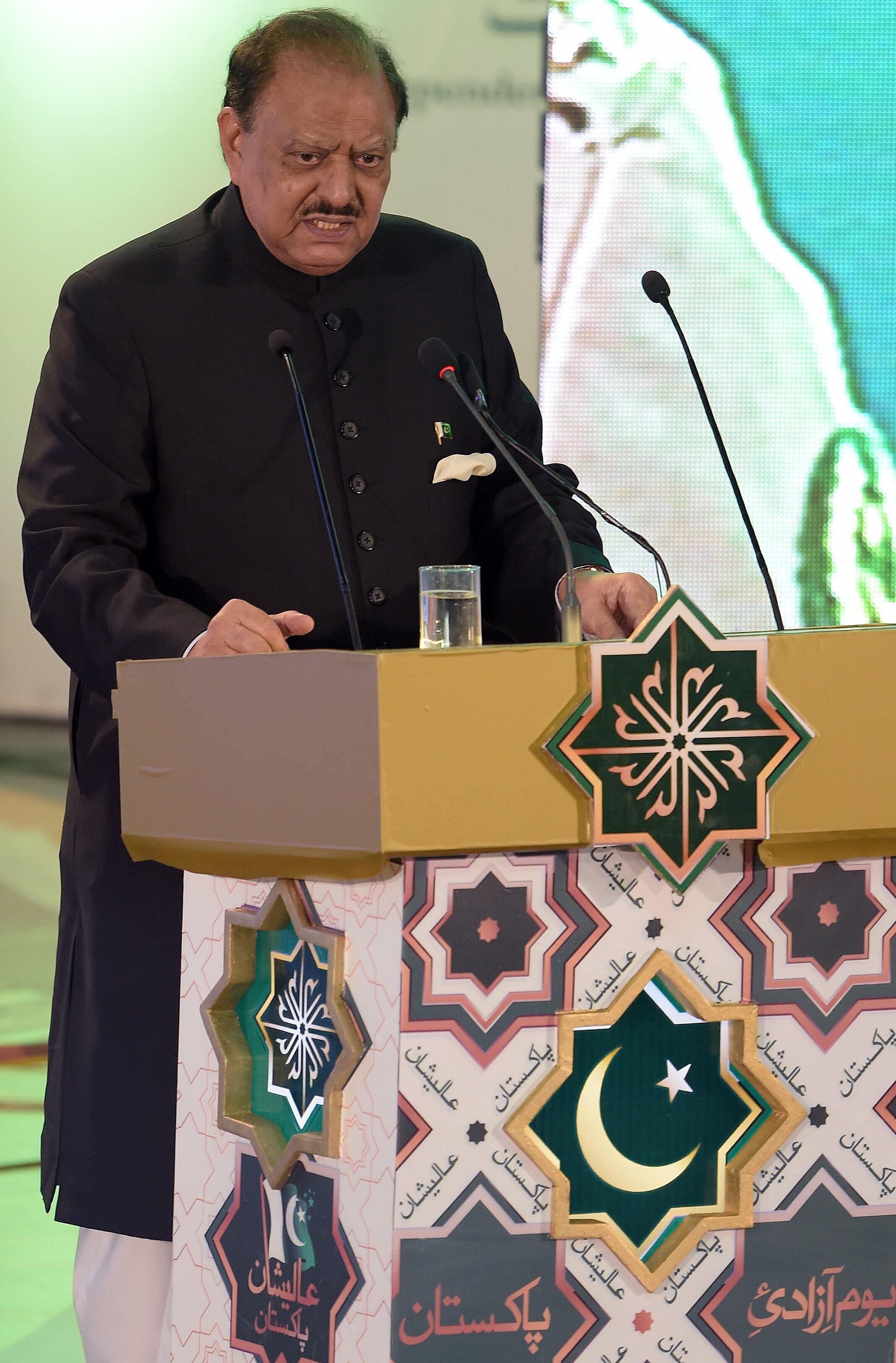
ISLAMABAD — Pakistan hopes more private sector participation in the defense industry will increase production and exports, said in the sector. This was stated by President Mamnoon Hussain at a seminar on public-private partnerships.
The as he addressed a two-day seminar, on "Public-Private Partnership in Defence Production and Export," was hosted by the Defence Export and Promotion Organization (DEPO) and held here that concluded Wednesday.
The seminar explored options for improving such a partnership and more effective related policies.
This is the latest effort by endeavor of DEPO and the government to increase defense exports. A new exhibition center featuring indigenous defense products was opened at DEPO's Islamabad offices in September.
Addressing the seminar, President Hussain said there was a need to improve defense production capabilities to ensure economic stability. This is needed because of what he described as , he said, He said this was necessitated by aggressive military doctrines and the import of high-tech weaponry into the region — that threatened to disturb peace and stability, (a thinly veiled reference to India's military modernization and "Cold Start" doctrine.
Hussain added that a public-private partnership (PPP) between state-owned and private industry would improve deliver the necessary improvements in the industry. He cited the example of Turkey in implementing a more effective PPP and increasing defense exports.
He however partly blamed inadequate marketing for the underperformance of Pakistan's defense industry to date.Islamabad Chamber of Commerce & Industry spokesman Mohammed Ramazan told Defense News the government could boost allow more private sector involvement by removing restrictions on manufacturing defense products to ensure the success of such a PPP.
"Presently, most defense production is in the public sector with very little in the private sector. This needs to be opened up, not 100 one hundred percent, but perhaps a little. The private sector has the best business practices and can contribute to defense exports," he said.
He cited the US as an example.
"In the US, for example, their private sector is fully involved and even making aircraft. ... Restrictions need to be removed to allow the private sector to play its role as well."
However, Haroon Qureshi, managing director of East West Infiniti, an Islamabad-based defense electronics and radio communications design and manufacturing company, who was present at the seminar, said believes many issues need to be addressed.
He has long highlighted inadequacies in project management as a restricting factor for the private sector.
He believes A model based more on the US practice of requesting for tenders, and then selecting two for prototype manufacture in a "playoff" is far more efficient than the current practice, which does not fund private sector defense equipment development initiatives.
He also sees does though see merit in the Turkish experience. (outlined in the seminar) that Pakistan can emulate.
"The Turks said special rules had to be made for Turkish private sector involvement several years ago that actually gave the private sector reasons to come into the military sector. Current Turkish defense industry rules state that 20 percent of all military industrial participation must go to SMEs."
Furthermore, Qureshi said believes there needs to be a shakeup at the helm of the defense promotion effort.
"Our [strategy for]capability of exports is misdirected. Most of this is because export efforts are all being manned by people in uniform; if we were to capitalize the worth of our conventional defense industry, i.e. [aircraft manufacturing factory], [Air Weapons Complex], [Pakistan Ordnance Factories], [Pakistan Navy Dockyard] they should be exporting over US$2 billion-$3 billion per year. But none are exporting anything worth writing," he said.
Adding, "Most news reports are for internal consumption and possible promotion to the next rank."
He says Deep-seated reform is also is required in the design cycle and long-term investment.
"Even in the design cycle, the capability of equipment at the correct price with competitive features and reliability, and delivery in a realistic time frame, need to be worked with the commercial marketing network ... the list of what needs to be done to achieve exports needs to be done," he said.
"Most long-term investment by the private sector is not forthcoming as the government and even the public sector defense industry, who subcontract work, look at the entire matter as supply orders governed by the Public Procurement Regulatory Authority, which provides guidelines for procurement by public entities; it does not cover development and production for military subsystems or the end product," he said.
As such "the current purchase regulations do not allow establishment of an inland letter of credit for orders placed with local industry."
Qureshi highlighted there had been Attempts at reform have been unsuccessful, Qureshi said. to change matters, but they were unsuccessful due to entrenched government practice.
"Recently retired Secretary of Defense Production Lt. Gen Tanvir Tahir, in his answers to questions, said he was unable to get any rules changed or modified in the procurement process to entice Pakistan's industry to produce goods for military applications, due to very bad government rules of engagement."
Unfortunately, Qureshi says he does not expect anything to change and this was echoed in the seminar.
"Dr. Ishrat Hussain, ex-governor state bank, head of the Institute of Business Administration Karachi was very well aware of the Pakistani engineering scenario, and said words in his speech that almost meant 'nothing will change' unless rules of engagement and payments are changed. These sentiments were shared by all from the private sector."
Email: uansari@defensenews.com
Usman Ansari is the Pakistan correspondent for Defense News.