MELBOURNE, Australia – The Australian government announced new steps to fix its ailing Air Warfare Destroyer effort on Dec. 9, with the appointment of BAE Systems, Navantia SA and Raytheon Australia to take on increased roles in the program.
In a joint press statement, Finance Minister Sen. Mathias Cormann and Defence Minister Sen. David Johnston said that for an interim period, the three companies will assist the Air Warfare Destroyer Alliance, a government-industry venture, with getting the AUS $8.5 billion (US $7.09 billion) project back on track.
However, the ministers noted that the program to build the three ships, based on Navantia's F100 class vessel, had slipped by 30 months for the first two ships and three years for the third.
Under the original contract, the alliance, comprising Australia's Defence Materiel Organisation, shipbuilders ASC and systems integrator Raytheon Australia, were due to deliver the first ship this month. The second and third ships were originally due to follow at 16-month intervals.
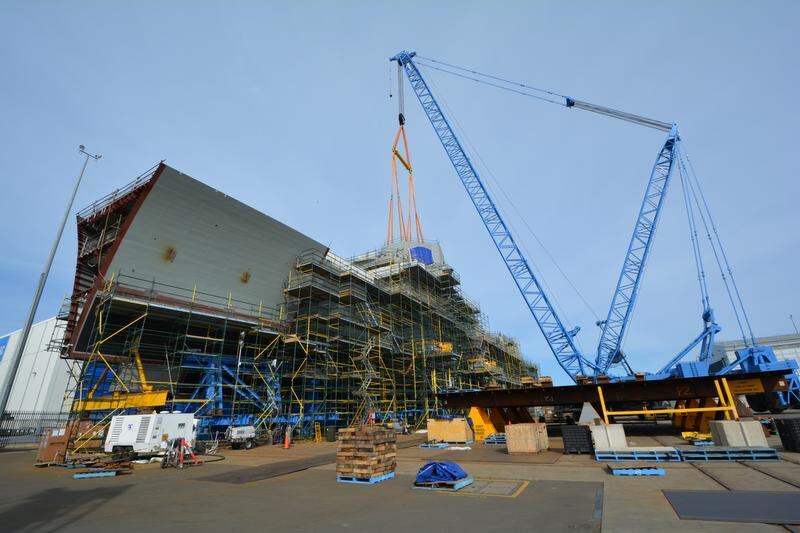
Hull blocks are being built around Australia and are consolidated at ASC's facility in Adelaide.
Johnston has criticized the program for being more than $400 million over budget, but Australian media reports have suggested this may now be closer to $800 million, and rising.
"We are taking the next major step to put the $8.5 billion Air Warfare Destroyer program back on track to deliver critical capability for the Royal Australian Navy," the ministers said in the Dec. 9 statement. "The interim period marks a turning point in the performance of ASC and its partners on this important project and will renew confidence in the future of Australia's shipbuilding industry."
ASC is owned by the commonwealth and slated for future sale. The Senate censured Johnston on Dec. 3 for saying he wouldn't trust the Adelaide-based company "to build a canoe."
Johnston was responding to questions from the Labor opposition as to whether Australia's $36 billion Future Submarine would be built in South Australia by ASC.
In his apology in the Senate the following day, he said he regretted any offense to ASC workers.
"Regrettably, in a rhetorical flourish, I did express my frustrations in the past performance of ASC," he stated. "In these comments I never intended to cause offense and I regret that offense may have been taken."
Johnston said last week that no decisions had been made regarding the long-term arrangements for the AWD program, but said the interim period will mark a "turning point" in the performance of ASC and its partners and predicted it would renew confidence in Australia's naval shipbuilding industry.
BAE Systems, Navantia and Raytheon Australia were engaged following a limited tender, following the release of a request for proposal in September, a Department of Finance spokesperson said.
Under the interim agreement, 39 additional personnel — eight from BAE, 11 from Navantia and 20 from Raytheon will work on the remediation plan.
Navantia is the original designer of the vessel and BAE Systems has built modules for the three ships at its facility in Melbourne.
In a statement to the media, BAE Systems Australia said it welcomed the opportunity to join the AWD reform project and described it as a "positive step" toward helping turn the project around.
The company will use its experience on building some of the AWD hull blocks as well as expertise gained in the construction and delivery of Australia's two 27,000-ton landing helicopter dock ships, the first of which was commissioned this month.
"Under the agreement, BAE Systems will be providing a team of highly experienced shipbuilders and executives from its Australian and global businesses to assist with reform activities," the company said.
However, the plan has also attracted criticism from analysts in Australia, who predict the arrangement will add yet another layer of management to the program.
Andrew Davies, a senior analyst with the Australian Strategic Policy Institute, said that while inserting experience in the day-to-day management of the build enterprise would almost certainly help, he described it as "AWD by committee."
"Call me old-fashioned, but I prefer someone to be put in charge," he said. "I think it's fair to say that a new pair of experienced eyes is always helpful. But that said, the new arrangement does little to remove one of the significant problems and that is the diffuse accountability of the AWD program.
"As (US) Adm. Hyman G. Rickover once said, 'if you can't point your finger at the one person in charge, then there's no one in charge.' "
BAE Systems had been widely tipped to be awarded the AWD management role, but the Australian government instead decided on the interim arrangement.
Davies noted that the inclusion of Navantia will streamline communications between designers, production engineers and the shipyard workers; Raytheon's role would expand from systems integration into the shipbuilding role as well. Still, BAE Systems appeared to be the main beneficiary.
"It is an effective promotion for BAE Systems," he said. "They have been promoted from subcontractor to a role in project management." ■
Email: npittaway@defensenews.com.